Lower Gearing for a GRX Groupset
My first gravel bike was the Reid Granite 2.0, a steal off Gumtree. It wasn’t the highest specced bike but for the most part it did the job. I did two bikepacking trips on it: parts of the Mundabiddi, and the Tasmanian Trail. Young and naive, I didn’t really appreciate just how under-geared I was at the time. After a particularly long and brutal climb up Poatina Road in Tasmania—which took the better part of the day—I started looking for ways to make these climbs easier.
Gear Inches
Needless to say, I wasn’t alone in my quest for easier climbs. In my research I stumbled across the unit of measurement “gear inches”, which distilled my days of suffering into a nice neat number. My Reid gravel bicycle’s number was 29. That number was too high for the heavy gear and offroad riding I was doing.
Much has been written about gear inches and gear inch calculations. I’d recommend checking out bikepacking.com’s write-up, which includes a gear inches calculator, so I’ll leave the explanation to the pros.
Alee Denham from CyclingAbout makes the following gear inch recommendations for bicycle touring. Note: I’m more focused on the lowest gear for climbing purposes.
- No panniers: 33 to 110″
- Panniers with 5kg: 29 to 110″
- Panniers with 10kg: 25 to 110″
- Panniers with 20kg or more: 20 to 100″
- Off-road touring: 18 to 100″
So as a fully loaded offroad bikepacker, I knew I needed to drop that number from 29 to somewhere below 20. I would be lying if I said the 2021 April Fools joke by Schindelhauer Bikes—the Wilhelm CCLII with 252 gears and a 3350% gear range—wasn’t incredibly appealing.
Gravel Explosion
Since the continued growth in popularity of gravel riding, we’ve been blessed with first-class support for wide-range drop bar compatible groupsets like Shimano’s GRX and SRAM’s Rival and Apex. It wasn’t always this way.
Traditionally, drop bar touring and bikepacking bike manufacturers would mix and match mountain bike and road components (check out these touring bikes from 2019), often combining officially “incompatible” parts.
On the DIY side, Wolftooth made the Goatlink and extra long b-screw to push the limits on cassette size.
My Reid Granite gravel bike is long gone. Like I would be caught dead riding a Reid bike nowadays (kidding…mostly). The latest set of wheels is a Merida Silex 700. Part of the appeal was the GRX Groupset and the super wide rear cassette range.
With my GRX822 derailleur already at its limits shifting a Shimano 10-51 CS-M8100 XT cassette, I turned my attention to the front. Taking inspiration from subcompact crank swaps (32/48T, 30/46T) which have become popular in recent years, I set off to see how low I could go.
Chainring Replacements
Rather than replace my perfectly functioning crankset, I looked at swapping just the chainring. Shimano make a 40T chainring for the GRX crank, but swapping from 42T to 40T would only drop me from 24 to 23 gear inches—still not low enough.
A well-placed Aliexpress ad led me to the Stone 34T chainring. With a 110BCD and some positive reviews on Reddit, it promised compatibility with my existing crankset and to give me the magical 18 gear inches I needed for my upcoming tour of New Zealand.
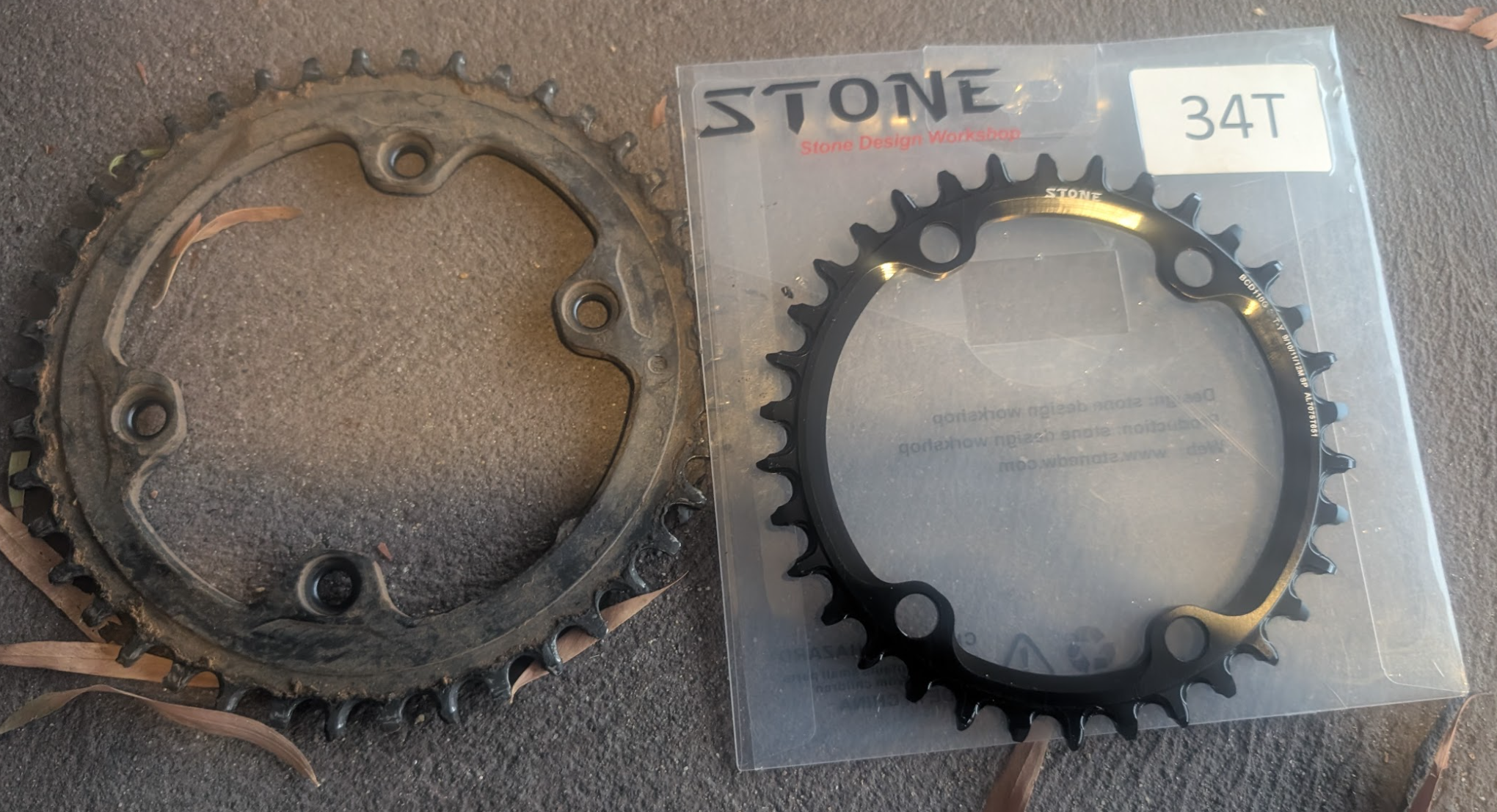
Installation
Easy. The instructions came in Chinese but weren’t necessary anyway.
- Take off the crankset and remove the existing chainring
- Screw in the new chainring (bolts and washers are supplied—I just used the old bolts.) I also like to use Loctite blue on the bolts.
- Reattach the crankset
As you’re changing the gearing significantly, you’ll likely need to shorten the chain. I was fitting a new chain in preparation for the tour anyway, so I sized it using this Park Tool guide.
Gravel Bike to… Mountain Bike?
My gearing now runs almost identical to a 1x12 XC hardtail mountain bike, blurring the lines between gravel and mountain bike even further. But drop bars are cool and gravel bikes are totally different from hardtail mountain bikes… right?
Maybe that’s a post for another time.